Round up the usual suspects

Jeff Stein, head coach of the 2016 NXL Division 2 series champs, Bay State Bandits, and former owner/coach of the New England Hurricanes, wrote an excellent piece on PBNation recently regarding try-outs.  It addressed both sides of that equation, the team looking for pick-ups and the players looking to be pick-ups.  You can find that article here:

http://www.pbnation.com/showthread.php?t=5477226

Jeff beat me to the punch as I was planning on addressing this very topic here at Zen.  During the off season, this subject is often one that is on teams/players’ minds.  As such, I thought I would add my 2 cents to the conversation.  Being involved to a small extent with the recent PC Katana divisional try-outs this past weekend and getting to see the talent and fun out there, it just made sense.

friday-117
From L to R- Air n Paint, yours truly, and Jeff Stein at World Cup 2016

When I host a try-out, there are very specific elements I look for in players.  I will engage and watch several players when everyone shows and is gearing up.  To the casual spectator, I am just being me…chatty, intrigued, and curious.  Unbeknownst to most, I assure you, I am being most nefarious.  I am looking for “tells” as well as gauging them on several different parameters (we will get into these).  I have a devious little system I developed several years ago regarding note taking in case I leave my clip board lying around.  In some instances, I have purposefully left it out as a test. What they will find are names with symbols and numbers next to them.  They will not be able to decipher it or glean anything advantageous from it… but I certainly learned something about you when I saw you try to read it.

Preparedness

I have always believed that being prepared is the half way point to success. That belief has served me and others I know well over the years.  So pay attention to those who have what they need for the day.  Many a player have come to me and asked to borrow something, whether it was a hopper, a tank, the notorious need for batteries, etc.  At that EXACT moment, I know you aren’t taking this serious enough to have the most basic necessities.  It speaks volumes about what I can come to expect out of you for the season. You are almost 90% done in my book at that point.

Let’s put that into perspective.  Would any other professional, no matter the profession, not be prepared?  Would a doctor operate on you before he or she understood your health history or performing the appropriate tests?  Doubtful, but if you find yourself with a doctor like that, I suggest you leave their office immediately.  Granted, we are talking about paintball, not someone’s health, but I firmly believe you should approach all activities in this manner.  If you don’t, we may not get along.  Before you attend a try-out or host one, ask yourself, “Would I be impressed by my own preparations?”   Teams/coaches know what you are looking for and know how you are going to look for it.  Have a set itinerary where you have a basic idea/guide of what you want to do during the day.  Players, be prepared to give your best and make sure you have everything you need as if you were already part of the team.

14971978_1421825141180355_797943131_n
Be prepared.. for every contingency

Socialization

This one takes a little explaining.  Most people, when you use the term in this context, think it’s about being social or “mingling”.  That is certainly something we should look for.  How comfortable is the player in his surroundings?  Is he easily engaged?  Does he listen intently, does he look you in the eye when you are talking (a factor I look for religiously), what is his demeanor?  But it is so much more.  Socialization is essentially learning appropriate behavior within an environment.  It’s a process.   Without attempting to teach a 101 course here, we want to understand if he can adapt to the team’s culture and how comfortable he is within it.  This is not something that necessarily will happen right away or that we can necessarily identify after so many hours (we will talk about that).  However, is this individual mature enough and socialized enough in a team environment in such a way that they can meet your requirements as a team member?  Perhaps there are aspects that denote they can evolve or are willing to do so?  There are nuances and behaviors you can look for, all of which involve our next topic.

15326041_10101172413581015_4130353908582698048_o
This is our culture or, at least, a part of it

Communication

I mentioned “tells” earlier.  The verbal and the non-verbal communication of a player can tell you a good bit.  Is he loud and abrasive or is he polite and helpful to others?  Does he talk about himself too much or does he not talk much at all?  When he speaks is he articulate?  Is he not afraid to ask questions and when he does, are they well thought out?  This goes both ways of course.  Did you give clear and concise directions?  Did you articulate well?  Did you explain from the outset what you are looking for?  Honesty is the best policy in these scenarios.

Regarding non-verbal communication, does the player avoid others and keep to themselves?  Do they carry themselves well?  What are they doing in between drills/points? What do these things say to you?  Watch them during the warm up.  Are they genuinely putting in an effort to stretch?  How quickly are they ready to go?  Are they first on the field or always lagging behind?  What are their reactions to losing a drill?  Are they helping others?

sunday-57
Communicating – it does a team good

One thing that I find most important is do they listen?  And when they listen, do they respond accordingly.  For instance, if we give instruction on a run and gun drill; “I want you to run straight to the corner on the break shooting back at home and the home player will be trying to lane you”.  Do they stop at a bunker on their way and edge out?  In other words, they want to beat the drill as opposed to follow directions (Another blog topic to be sure).  Perhaps they wanted to show us how a “smart” player would do it.  All you showed me is you don’t listen. No Bueno.

Positivity

This is probably the most self- explanatory.  Nobody likes the Debbie downer or, in particular, the guy who starts picking those around him apart, even if he is doing it quietly.  I like there to be energy whether it is a quiet fire of focus or a loud happy positive guy who you can tell just loves being there and is thankful for the opportunity.  Look for people who will be themselves.

Physicality

Obviously, you want a person who can handle the physical stress of our sport and they should have a sense of coordination.  Whereas, our sport has become more and more about athleticism, you don’t have to have a Bo Jackson or Usain Bolt.  But the individual should at least be able to run a few points without strain.  I am a firm believer in the importance of the fundamentals, as well.  They should show a competent amount of coordination and at least have a basic understanding of these fundamentals.  This, of course, can vary depending on your division.  There is no forgiveness for a D2 player or higher who does not have an understanding of basic fundamentals. (Possibly a D3 player as well).  This goes hand in hand with the communication part though.  Are they coachable?  When they listen to they really make an effort?  Do they adjust and try your suggestions?


img_20160612_133659
What’s in your wallet?

Some other notes

Be up front from the get go when hosting a try out.  You need to manage expectations from the start.  “We expect everyone to be able to afford a minimum of 2 cases per practice” or “We will be out at the field every Saturday at 8 am to set up and everyone will participate”.  Something that is beneficial is have your goals, requirements and expectations typed out on a hand out that you can then dispense amongst the guys there to try-out.  Put some serious thought into this.  Don’t be draconian, but have some fun with it too.  It will show the guys you are human.

I think it goes without saying that you shouldn’t commit to a player after just one try-out.  Be sure to state this from the start as well. Whether your try out is one day or two, when you decide on a player(s) that you feel will compliment or add to your roster, explain that you liked what you saw and you would like to see more.  Would they be interested in joining the team for the next few practices and see how things go before you commit?  This will allow you to see their consistency (if it exists) as well as a better feel for their interaction and abilities.  This is in the player who just tried out best interest as well.  He may not like what he is seeing or feeling regarding the team.

I will close with this.  I would much rather have a hard working, coachable player, who listens and wants to be there and who wants to improve then a superstar any day of the week.

Be water my friends

Bianca

Honestly… who throws a shoe?

94587-who-throws-a-shoe-meme-austin-prfd


“Honesty is the first chapter in the book of wisdom.”

  • Thomas Jefferson


We have all met him; the super star of paintball, the unsung hero who pulled off a 5 pack when he used to play with that pro team against that other pro team back when pro teams were pro teams and before all the hubbub… except he isn’t unsung.  He is singing right in front of you and the rest of your team at try-outs, talking about his glory days.  You listen intently and politely knowing he was never rostered with said pro team and that the scenario he is describing is complete fiction, especially as he moves on to explain all the (fabricated) reasons why he isn’t in the realm of paintball stardom amongst the greats. Hollow excuses that make no sense, and should you decide to call him on it, you know it will just get dumber so you don’t waste your time.  You decide to let his game talk and true to form, he doesn’t disappoint.  He is about as talented and successful at paintball as OJ Simpson would be at speed dating or Hillary Clinton staying sober on the most recent election night.

On the opposite spectrum, how often do we look in the mirror?  Where do we feel we stand as a player?  People like the one described above are easy to spot and even easier to deal with on the field.  But what about us?  Are we really as good as we think we are?

Let’s talk about self-assessment.

Self-assessment is a necessary evil in all walks of life.  We have to understand where we stand, in real time, in relation to our goals.  Those goals can be at work, in our relationships with significant others, and of course, our performance on the paintball field.  Self- assessment is important quite simply because it should always lead to self- improvement.   Ah-hah!

friday-101
Reassessment needed stat!

First things first, when we recognize our mistakes and understand why they happened, we can then begin the process of improving.  Now, you’re probably saying, “Sounds about as obvious as it can get”.  And, for the most part, you would be right.  We have to admit to ourselves WE made the mistake.  As we become better at doing this, it eventually becomes a habit; habits that will over time make our lives better in all things, not just paintball.  The great thing is, the better we get at doing this, the better person we can become.  Why?  Think about it… who are we going to for “self-help”?

However, I would be remiss if I didn’t warn you that self-assessment can be a bit of a pooch too. The key to its success is being honest with you.  Let’s face it, most of us avoid honestly assessing ourselves and there are several reasons for this. We tend to distract ourselves from the objective of self-assessment, never fully commit to it, and we have a tendency to make excuses.  Heck, we are human after all.

Be advised, when done wrong, self- assessment can be more damaging than helpful.  We must be careful not to take it too far and do it too much, eventually creating a dismal outcome for ourselves no matter what.  Understand that, we should still strive to confront ourselves on and off the field regarding our strengths and weaknesses.  As long as we keep it within the realm of controllable capability (focusing on things we can control as opposed to outside elements) we can work towards making serious improvements.  But lets not beat ourselves up.  Let’s recognize the process and why we did it to begin with… to improve.

sunday-51.jpg
Self assessment?  I look good…

Here’s how I see a beginning assessment regarding competitive paintball going down:

How do you spend your time at the field?  What does a normal practice day look like for you?  How is your snap shot?  How is your laning?  How is your run and gun?  How is your communication?  Do you leave the field feeling accomplished? How is your physical being?  Are we in shape?  Are we hydrated? Do we enjoy practice?  Do we like our teammates and trust them?  Do they trust us?  What do you consider your best trait on the field?  Why? What do you consider your weakest? Why? Where do you think you need to devote more time and energy?

And now for the biggun’.  How do we measure ourselves against all these things realistically?

Ask yourself those questions and answer as genuinely as possible.  Remember, the trick is to assess your strengths and weaknesses honestly.  Once we do this, we can move forward by focusing on correcting the weaknesses and strengthening the strengths.  Don’t look at your weaknesses as failures; rather look at them as what they are:  Opportunities for improvement.  Get it?  But don’t limit yourself to just those questions.  Take it further!

img_20161023_130355
Self assessment with friends can be a lot of fun… and healthy for a team.

Let me shift gears here for a bit but stay within the same realm of relevance.  Once you realize there may be some things that need to be improved or possibly even re-learned, you need to hop on them immediately.  One thing I have learned over the years is that, those who learned paintball by just playing points, are the most difficult to help adjust/improve.  However, it isn’t impossible, especially if they remove the ego from it and recognize it needs to be improved.  Relearning something doesn’t have to be a monumental feat.  It just takes patience and training.  Learned behaviors are a lot like taking your dog out for a walk.  You take the same path every day, day after day after day.  One day you decide to change it up but he hesitates on the leash.  However, over time, the more you take the new path; he will eventually start making that turn with you as the behavior is relearned.  So don’t get discouraged.  It will not happen overnight.  Recognizing this from the first will help. Oh, and no, you’re not a dog.  But you can learn new tricks…

Once you have conquered yourself, then it becomes a simple matter of applying the same concept to the team.  Coaches, you should do the same… to your selves.  Self-assess regarding your coaching and your own abilities.  Maybe share your own findings with the team for increased feedback.  Trust me; it pays off in the end.

I’ll close with an example of myself.  I feel I am adept at laning, run and gunning, snapping and other gun fighting skillsets.  Where I struggle the most is communication and being overly aggressive.  My communication is good the beginning of the point but my mid game and, to a lesser extent, my closing coms can (and should) be much better.  My aggressiveness comes from making and seeing reads on the field as things unfold and I like to take opportunities.  Regrettably, I don’t always communicate that to my teammates.  So, leading up to World Cup, I really emphasized my own coms by challenging myself to communicate better mid game and tried to play a little slower.  The best part is I got to work on these things with the team I was playing/coaching and we grew together.  My guys helped me by letting me know what was good and what wasn’t.  And we watched a bunch of tape too… but that’s another blog.

11923207_10206578720762156_3462283109897667509_n
Damn skippy

So, this off season, take a good look at you.  Find the chinks in the armor or whether you’re wearing armor at all and get to improving yourself and your abilities by taking a good hard look in the mirror.  Promise to try, do, and be better than the old you.  Improve yourself.  Become you 2.0 or, in my case, 47.5 beta version.  You will thank yourself in the end.

“Attack the evil that is within yourself, rather than attacking the evil that is in others.” ― Confucius

Be water my friends,

Bianca

LOL… he said “convivial”

We’re going to talk about a topic that I don’t believe too many address when giving advice in paintball.  I have found myself saying this more often as of late.  It may be due to my age.  But I believe there is a significant benefit derived from this one thing when it comes to improving your paintball game.

I have said several times over the years that, once I am no longer effective on the field, that is the day I hang up the jersey and walk away.  I have tried to stick to that particular statement for some time now.  But I noticed something happening earlier this year.  That statement or rather the reasoning behind, began to evolve, just as many of my perspectives have over the years (ask me about 9mm vs .45 sometime).  Yes, I am competitive and want to give the very best I can, every time I step on the field.  Not just in matches or games, but in practice, drills, teamwork, etc.  However, the evolution of the statement was subtle.  I play paintball because I enjoy the game.  It is fun to me and has several elements that attract me to the sport.  And so, the statement became this: The day I stop having fun while being effective on the field is the day I will walk away.

Don’t get me wrong.  Winning is fun, right?

14523294_1751510265102521_2573540879364517500_n
Ewoks are fun.

“Just have fun!”  Yeah, sure, sounds simple enough, yes?  But is it? Almost every competitive paintball player I know wants to win and winning is fun.  But admit it, those events you travel to with your teammates, your friends… you want to have a good time.  Of course, you are traveling there to win!  But you want to have a good time, a good experience yes?

It is easy to get caught up in the moment, become so serious, that you forget to have fun and instead stress yourself out to no end.  Trust me, this is something I have a lot of experience with.  Some of you may be asking yourself, there is no time for fun if you are serious about winning.  And that very well may be true… for you.  You are probably thinking, there is no time for fun when the game is on the line!  And this is where I would say, “Well then, you’re doing it wrong.”  The having fun part that is.

See, the fun doesn’t start when we get to the tournament.  It starts right now.  It started when you decided to put time and energy into paintball.  How many of you started playing paintball to win a tournament?  Chances are you started playing to have fun with your friends.  It was FUN to play.  The tournament part came later.

13240484_10154291428073010_7673575149588675552_n
Winning is fun too


I am currently researching sports psychology articles that support my theory but I firmly believe that you garner more from practice when you are enjoying yourself.  I feel you have to enjoy practicing before you can truly enjoy competing.  You have to want to be there.  You have to want to be there because not ONLY do you want to get better but because getting better should be enjoyable.  If frustration sets in during practice, we need to refocus you on the task at hand.  See, frustration is in your head.  If you are always frustrated with a drill or skill set, you are training wrong mentally.  You don’t have to be frustrated to get better.  You shouldn’t have to force yourself to be miserable to get better at something you enjoy.  Read that last sentence again and let it sink in.

If you end up leaving the practice field feeling as if you could have done better or trained harder, you didn’t have a good time in my opinion.  Recognizing that you are getting better should be enjoyable.  See, too many times we get to the field and we get so caught up in our mistakes we don’t recognize what good came of them.  Practice is where you are SUPPOSED to make mistakes.  Better there than the tournament, yes?  A great practice should be one where, we can make mistakes, learn from them, recognize the mistake and why it is one, and forgive ourselves.  If we constantly beat ourselves up over the fact we are still making mistakes, that is not conducive to getting better.  It’s going to happen, you’re going to make a mistake.  Recognize that as part of the process of getting better.  Think about it, you can’t give more than you can give, right?  If you are giving 100% and doing your best every time you pick up the gun, then you are doing what needs to be done.  Having fun is allowing you to make mistakes and forgiving yourself for these mistakes. You can’t give more than everything you have in training, and you can’t undo what’s being done. When someone tells you to have fun, what they are saying is: “Do your best because your best will do.” Even when your “best” is not enough to “win”, you can never win if you don’t believe you deserve to be there or want to be there.  Who spends that amount of time and money to go to a tournament to lose?  No, you want to give it your best and have fun doing it.

During my research about enjoyment/fun and the correlation to success, I came across a statement that I wrote down.  It actually became the catalyst for deciding to write on this particular subject matter.  Check it out:  “Fun without excellence can actually work against you because the credibility is not there.” It made me start thinking about my own successes at work or paintball or leadership.  I realized that, over the years, there was a common theme to certain successes in my life; humor.  If I did my job well but was able to work some fun into, maybe take a serious topic or moment and figure out how to inject some humor into it, it appeared things went more smoothly or were more impactful or effective. So let’s look at it from the perspective of process.  Each process has steps that are followed in order to gain a desired result.  Ok, let’s start there.

14089132_10154538541488010_2306425010083407079_n
Not fun!  Not fun! lol

Practices should be designed as a series of processes (drills, scrimmaging, etc.) in order to improve our individual and team abilities.  If we take each process and analyze what we don’t like, what works and what doesn’t work, then we can identify a way to make it better.  I bet if I were to survey most players, the majority of them don’t necessarily enjoy certain drills.  However, almost everyone knows that drills are designed to improve our skillsets.  So, if drills are necessary and required to get better, what can we do to make them more enjoyable?  Interesting question, no?  See, we have more control over how we improve than most people realize.  It just takes a little creativity.  And if I know one thing, PB players are a creative bunch.

I think that the biggest challenge most of us face would be that we aren’t good at recognizing how good (or bad) we really are.  I see it pretty often, a player will overestimate how good they are at a particular skill set (I’m starting to sense another blog post topic…hmmmm).  However, if we are able to decipher input from our own practices and recognize where we struggle, then add input from our teammates, we should be able to understand what we truly need to be working on and what we need to improve.  And that doesn’t have to be depressing, that can be fun!  Understanding where we are helps us realize where we need to go.  Once this happens, we can begin setting aside a certain amount of time each practice and really focus on those skill sets.  But make it fun.

13245271_10154291413018010_2209736001154679009_n
Rule #1 – Have fun

The point of all this is to say that; I believe that you retain more and learn faster when you are having fun.  Does that make sense?  So coaches and players, have fun out there.  Work hard, play hard, and have fun.

Okay, that wraps this one up.  I hope it makes sense.  Feel free to let me know your thoughts on the matter.  Until next month…

Be water my friends

In the Presence of Royalty

Having assisted in the development of the Prime Program over the past 6 years, I can comfortably say I am a creature of habit. Team owner/manager Mike McGowan and I have settled into a few routines which we feel are the more practical and effective means in which to grow a players fundamental abilities as well as assist in creating a team environment. These routines work, for the most part, when applied correctly to the appropriate and willing player.

I have always felt that when you incorporate routines into your training, you can’t help but promote something that is imperative to any form of success; discipline. Discipline allows players and coaches to commit to the goal at hand. Those without discipline will never be reliable and therefore cannot succeed when pursuing a competitive goal or any other goal worth pursuing.

56
Routine drills. They do a body good.

Why do most people in our sport have an aversion to routine? To me, I can only come to one conclusion; fear. They’re scared. Now, I am not necessarily referencing cowardice, although that very well may be the issue, but more along the lines of loathing. They hate routine because it is boring, it isn’t exciting. “I want to play points, not drill!”
Despite all the positive benefits that can be reaped from routine, people still resist it.  However, not as much as they resist change and the unknown. Studies suggest we actually fear an unknown outcome more than we do a known bad one (that vexes me). I love routine but I am not afraid of change. As a matter of fact, I enjoy trying new things. So I am a creature of habit as well as a bit of an adventurer.

12105769_904191556339322_2966187740819618959_n

How did this photo end up here?  Oh well… sorry California

I fear no man. Hold up…. Scratch that and allow me to quantify that statement real quick. Yes, I fear a nuclear Iran or a person carrying a biological weapon. But I fear no man in my immediate accessible small world. Don’t get me wrong, I don’t want to be made a fool or seriously injured or find my family in danger without me being able to help. But I know that, put in most situations, I am prepared. Being prepared is how I look at routine versus change. They both have their benefits and we should strive for both. Balance of two forces is a good thing. Yin and Yang… but I digress.

THAT is how I found myself out in San Jose, CA and ultimately in Las Vegas, NV for the WCPPL Sin City Open this past May with the Royalty program. They had a D2 squad with whom I was playing and a D4 squad who was competing at the event,as well. It was an adventure I will never forget.  By stepping out, I learned more in those few days than I have from the last 3 events I attended with my own crew. I highly recommend that, should you find the opportunity to “guest’ with a team, you do so. Whereas, I am certain there are incidences where it proved to be a difficult, uneventful, or even a terrible ordeal for some, I would venture to say that, more times than not, it would be a truly positive experience.

57

Don Nosweiger and yours truly

 Don Nosweiger captains the Royalty program. Don and I met through our mutual friend Shane Pestana last year when the Prime Program flew out to San Jose, CA to scrimmage Royalty and the Los Angeles Ironmen. A truly humble and gracious man, Don made me feel welcome and integral to the program almost immediately. His approach to his crew is quite different than my own but I found it fascinating and an opportunity to see how others approach running a team. It proved to be an amazing learning experience. I truly enjoyed talking shop with Don regarding different approaches to leadership, personality types, team dynamics, accountability, motivation, logistics, incentive, practices, game planning, tournaments, and more. Some approaches we had in common, some were somewhat similar, but others were significantly different. It was eye opening and worth every moment.

Then there was actually playing WITH the team. It’s one thing to practice with a team you have been a part of from its inception. It’s another to practice with a team two weekends prior to playing the event. With the latter, you can still learn enough about the team and what to expect from them at the event. You learn certain nuances and mannerisms. You can even pick up on the movers and the shakers. But it is something completely and entirely different coming into an event having never practiced with a single member of the team. Going in cold, I found myself a bit anxious. Here was a chance to integrate into a new environment and see where I stood on this sort of scenario. But I was really excited about the opportunity. After all, I was going to meet some new guys, hopefully make some new friends and see what West Coast paintball is all about.  I was looking forward to learning and possibly sharing my own insights.

58
Clocking in


Long story short, I couldn’t have asked for a more fun and relaxing experience. I want to give a big shout out to the Royalty guys. They are scrappers and I like scrappers since I fancy being one myself (Me! … Inside joke, bear with ME!).  Don, Andrew, Alex, Tanner, Clayton, Kona, and Sean, I want to thank you all for allowing me to guest with you. You guys are family now. I will make southerners out of you yet! I would be remiss if I didn’t give a shout out to my other crew, too! Jr, Hugo, Christian, Mason, Mylo and Jason, see you boys real soon! And Trevor, thanks for making me look somewhat respectable in those photos!

Whereas our outlooks, our lifestyles, our geographies are all different, one thing we certainly had in common and that was the desire to win. I highly recommend stepping out of your comfort zone and experiencing other programs should you have the opportunity. If you decide to do this, there are a few things I would ask that you take to heart…

59
Family isn’t always blood…

When you go out on a limb and try something new and foreign, when you put yourself out there… that takes courage. Interestingly enough, the ability to summon courage becomes easier and easier the more you do it. After a while, when you call on it often enough, when you become brave, it will become contagious. This will open a whole gaggle of new experiences and opportunities for you. And guess what? It might even become routine. Your “fear” has dissipated.  Congratulations warrior.

When you become courageous, stand in front of a new world, and exclaim, “I am!” you will never be bored, I promise you that. The constant challenge, even with those of us who are slaves to routine (it’s the challenge that keeps it new for routine people), will always bring excitement, the excitement of bettering yourself. When you have an opportunity to learn or to grow, you have to jump at that, grab on with both hands and never let go. Remember, we don’t grow by never stepping out. We grow from new experiences which allows us to forge new attitudes which forge newer actions, new directions and ultimately new life.

60

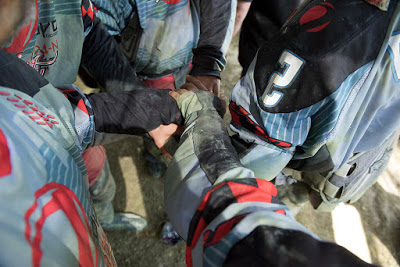
“Bloody!…Knuckles!”  Joining the team in getting pumped up

This doesn’t mean I stop enjoying my routine or what I am comfortable with. No, I continue to enjoy those things, I am just expanding my appetite. But for me, trying new things isn’t about just enjoying a new activity or experiencing the unknown. I really am content enjoying all the things I already enjoy. But straying into foreign lands, both metaphorically and literally, has always forced me to challenge my beliefs. And as painful as that is, I believe nothing contributes to our happiness more than shattering the delusions to which we cling.  Often we are unable to distinguish between beliefs that are true and beliefs that are false, especially beliefs about ourselves. And for better or worse, we simply seem unable, most of the time, to identify a belief as delusional unless someone we trust or some experience shows us.

In the end, I find the spirit to try new things synonymous with the spirit of self-improvement. And while I can’t honestly say I’m intrinsically prone to the former (I sometimes need a gentle reminder to do it from people around me), the latter is a large part of the reason I’m here.

61

Bama came to Sin City and saw things

Developing newfound knowledge and making it ultimately our own can be scary, fun, exciting and downright painful. But it’s the journey of discovery that is ultimately worth it. Bruce Lee taught, “Absorb what is useful, discard what is useless and add what is specifically your own.” I would add that when you discard what is “useless”, you don’t forget it… for we learn from its uselessness.

Get out and play with different people. Get out and learn different approaches and theories. In the end, you have everything to gain and nothing to lose.
Be water my friends,

Bianca

62

Good times with new friends.  Looking forward to more


Previously Posted

Save